
Germantown Voter Registration Lookup
The Maryland State Board of Elections Voter Lookup lets a Germantown voter review the voter’s own record. It is identity-gated, not a browseable roll. The service updates each day, although a submission made that day may not yet appear. An online or Motor Vehicle Administration registration may take up to three weeks to post. Enter the registered form of the name and the residential ZIP. Street number and middle initial can help narrow the match but are optional.
| Lookup field | Input | Required | Exact entry rule |
|---|---|---|---|
| First Name | Text | Yes | Letters and spaces; use the registered name |
| Last Name | Text | Yes | Letters, hyphens, and spaces |
| Birth Month, Day, Year | Numeric | Yes | Month 1-12 and day 1-31; inspected year validation showed 1921-2010 |
| ZIP Code | Five digits | Yes | Maryland residential registration ZIP |
| Street Number | Text | No | Accepts letters, commas, hyphens, and slashes |
| Middle Initial | One letter | No | Single alphabetic character |
Search inputs are proof-of-identity details. They are not the same as fields released in a voter list. A successful query can confirm registration, show polling and district information, identify the local board, offer a duplicate-card request, display a sample ballot, and report mail-in or provisional ballot status.
The official form can be checked before typing personal details. The Germantown voter registration self-lookup appears in the captured view below.
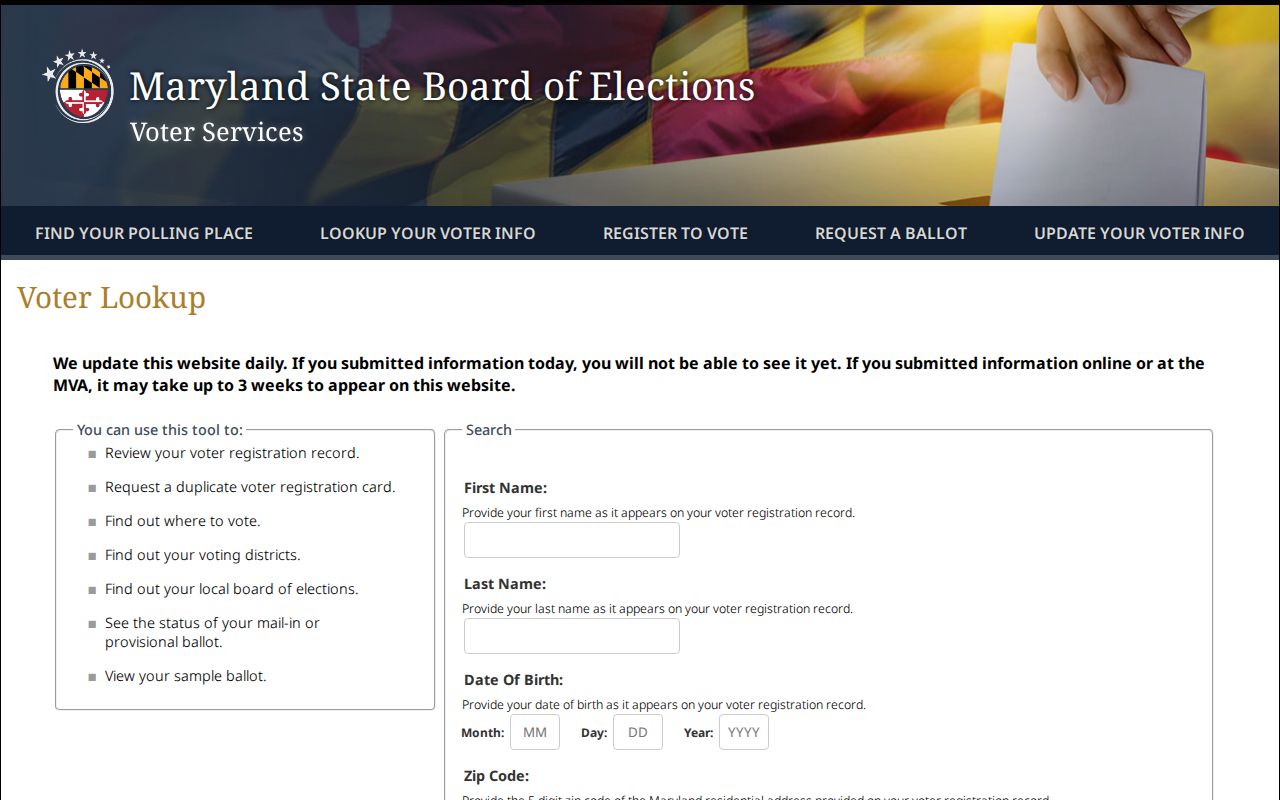
Its fields reinforce the service’s narrow purpose: confirming one voter’s information, not searching the public by surname.
Fix a Germantown Lookup Miss
A blank result does not prove that a registration was cancelled. Start by trying the exact registered first name, such as Jeffrey rather than Jeff. A prior surname or former ZIP may still be the right key after a recent change. The optional street number accepts several punctuation forms, and the tool’s help says letters and half indicators are not needed.
Wait through the stated posting period if the voter registration transaction was recent. If the record still fails, the Montgomery County elections office is the local custodian for registration, card, precinct, and list-maintenance questions. Germantown is not a separate election jurisdiction, so there is no Germantown city election file or municipal voter desk.
Note: Treat an online miss as a reason to verify with the local board, not as proof about a person’s eligibility or residence.
Fields in Maryland Voter Records
The revised state application defines the fields in an authorized Registered Voters List. They include voter ID, name, party, gender, residential and mailing addresses, active or inactive status, state and county registration dates, precinct and split, and several district assignments. Those districts may include congressional, legislative, councilmanic, ward, municipal, and commissioner fields. County is included as well.
| Identity | Voter ID, name, party, and gender |
|---|---|
| Addresses | Residential and mailing addresses, subject to protected-address rules |
| Registration | Active or inactive status plus state and county registration dates |
| Voting geography | Precinct, split, county, and applicable election districts |
| Participation history | Election, voting method, date, precinct, and location in the separate history product |
Protected voter data. Under Maryland Election Law §3-506, a Safe at Home participant’s residence address may not be disclosed. Full birth date, Social Security and driver-license identifiers, signature, and source-agency data are not ordinary list fields.
A lookup may ask for a full birth date and address to identify the voter. That does not make those inputs open for public browsing. The split between authentication data and released list data is central to reading Maryland voter records correctly.
Germantown Voting History Limits
Voting history reports participation, never the selections marked on a ballot. A separate history file may show voter ID, election date and description, election type and code, party, voting method, date voted, precinct, early-voting location, jurisdiction code, and county. The voter ID acts as a join key, meaning it links a history row to the matching registration row.
The application also offers history with a Registered Voter List for up to ten elections, with five included columns, or as a separate event-by-event file. The simpler included columns omit method and date details. Neither version reveals a candidate choice or vote on a question.
Does a history row show how someone voted? No. It only indicates participation and related process facts. Ballot secrecy remains intact.
Choose a Germantown Voter File
The State Board’s voter-data application offers more than one product. A Registered Voter List supplies the core registration fields. A Walking List is an uneditable PDF grouped by precinct and street, with residents and party beneath each address and even and odd sides separated. It is not sold as a statewide product.
- Registered Voter List, with optional participation history
- Walking List by precinct and street address
- Mail-in and permanent mail-in applicant lists
- Provisional, early-voting, and cure lists for a named election
Mail-in data may include the ballot address, request type, and request status. That is not proof a ballot was returned. Provisional and cure fields are snapshots of election processing and need the election context. Applicants can limit the geography to an offered county or district and can choose active voters, registration dates, parties, or all registered voters including inactive records.
Request Maryland Voter Registration Data
Only a Maryland registered voter may obtain these list products. The applicant must give identity and contact or organization information, select the product and limits, choose delivery, pay in full, and sign a perjury declaration. The oath limits use to a purpose related to the electoral process. It also bars commercial solicitation and distribution, sale, or transfer.
- Download the current application and choose the list, voting-history option, geography, party, status, and registration-date limits that fit the electoral purpose.
- Print or type the applicant details, sign and date the oath, then select secure FTP, flash drive, pickup, or mail as offered.
- Submit full payment to the Maryland State Board of Elections. The form states production is within ten working days after receipt.
A statewide, county, or district product costs $125, $75, or $75 respectively. Secure FTP delivery is free with email. A flash drive or mailing option adds $15, and large files generally are not emailed. Products other than the Walking List arrive as tab-separated text without text delimiters. The Board provides no custom format or technical support, and a large file may exceed common spreadsheet limits.
Applications received after the advance-registration deadline before an election are returned under COMAR 33.03.02.05B. The Board’s file-request contacts are 410-269-2840, 800-222-8683, and dlPSR_sbe@maryland.gov.
Germantown Voter Record Restrictions
The signed oath is a legal limit, not a routine checkout box. Maryland Election Law §3-506 confines voter-list use to the electoral process. The current form forbids commercial solicitation, resale, transfer, and unrelated use. It states that misuse is a misdemeanor punishable by 30 days to six months in jail, a fine up to $250, or both.
Use the list lawfully. Never use voter records to threaten, stalk, or harass a person. Report suspected voter-list misuse to the state or local elections board.
The general Maryland Public Information Act does not override this record-specific election law. For the broader system of custodians and requests, see Germantown public records access. Voter registration data retains its own eligibility, oath, product, and penalty rules.
Germantown Registration Status Changes
Maryland Election Law §3-101 establishes the statewide voter list and requires current participation history for at least the five prior years. State and local boards maintain the roll and coordinate address-change data. A move within Maryland does not by itself require a brand-new registration while the voter remains registered.
Inactive status is administrative. It is not proof that someone moved, died, or lost eligibility. Address confirmation and statutory procedures govern inactive and cancellation work. A voter should rely on board notices and direct confirmation, not draw a personal conclusion from a status field.
Note: Germantown status questions go to Montgomery County because the community is not an incorporated election jurisdiction with its own voter roll.
Montgomery Voter Rolls by Numbers
The State Board’s June 2026 report counted 707,821 active registrations in Montgomery County and 56,537 inactive registrations. Active totals were 407,996 Democratic, 99,272 Republican, 1,093 Green, 517 Working Class, 189,455 unaffiliated, and 9,488 other registrations.
These are county figures, not Germantown voter registration totals. Postal Germantown, the census-designated place, precincts, school zones, and planning areas do not share one boundary. Producing a defensible Germantown count would require documented precinct-to-CDP geographic analysis. Simply assigning every Germantown mailing address to one local boundary would overstate precision.
Older election research follows a different path. Exact Germantown precinct-register years were not confirmed in the accessible Maryland State Archives catalog material. Search the Archives election-record series by Montgomery County and precinct, then ask the county elections board which poll books or registration records remain in local custody. A historic name should be tied to the precinct and election date before treating an entry as the same person. This archive-and-board fallback is more sound than assuming the modern online lookup reaches prior rolls.
Separate Germantown Record Lookups
Voter status should not be stretched into proof of identity, current occupancy, or a person’s professional standing. Maryland maintains separate systems for separate facts. For example, the Division of Occupational and Professional Licensing gateway routes users to profession-specific boards where a credential can be checked by the fields that board publishes.

The captured gateway illustrates the custodian rule: use voter registration for election status, and use the relevant board when the question concerns a license. One record should not be treated as a substitute for another.